
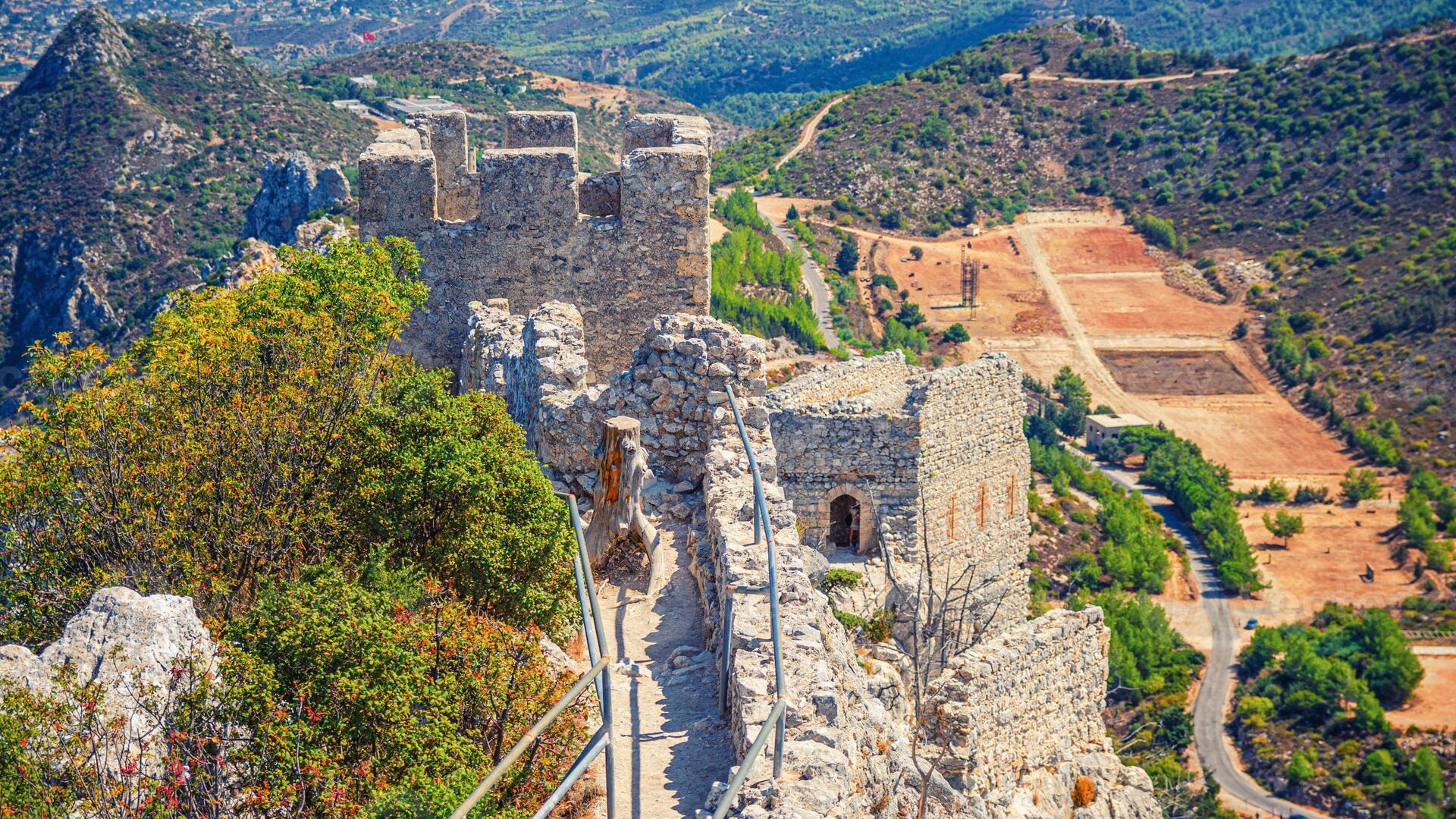
The Snow White Connection: Walking Through The Clouds at St. Hilarion
The Castle That Inspired a Fairy Tale
There is a place in Northern Cyprus where the boundary between history and legend dissolves into the mountain mist. Perched on the jagged spine of the Kyrenia Mountain Range — known locally as Beşparmak, the "Five Finger Mountains" — St. Hilarion Castle rises like a vision conjured from the pages of a storybook. Its silhouette, with crumbling towers that pierce the clouds and battlements that cling impossibly to cliff faces, is said to have caught the imagination of none other than Walt Disney.
The story goes that Disney, during a Mediterranean cruise in the 1930s, was so captivated by the sight of St. Hilarion against the sky that it became the seed for the iconic castle in Snow White and the Seven Dwarfs (1937). Whether verifiable history or charming apocrypha, one glance at the fortress and you understand why the legend persists — this is a place that looks, quite simply, too magical to be real.
Ascending Through a Thousand Years
The climb to St. Hilarion's summit is a journey through time itself. The castle unfolds across three ascending wards, each built by different rulers over a thousand years, each revealing a new chapter of the island's turbulent past.
The Lower Ward: Where Soldiers Stood Watch
You enter through a fortified gatehouse and immediately feel the weight of the centuries. This was the garrison — stables, barracks, and storage rooms carved from the living rock. The Byzantines built this first layer in the 10th century as a defence against Arab coastal raids, naming it after the hermit monk Hilarion who fled here from the Holy Land. The silence here is thick, broken only by the wind whipping through arrow slits.
The Middle Ward: A Church in the Sky
Climbing higher, you reach a beautiful 10th-century Byzantine chapel — its barrel vault still intact, traces of ancient frescoes whispering from the walls. Nearby, a small belvedere offers your first true panoramic view: the Kyrenia coastline unfurling below like a painted scroll, the harbour's horseshoe curve glinting in the sun, and on clear days, the faint outline of Turkey's Taurus Mountains shimmering on the northern horizon.
The Upper Ward: The Queen's Window
The final ascent narrows. Stone staircases spiral through passages barely wide enough for one person. The air grows cooler, thinner. And then — the Queen's Window.
This is the moment that makes the climb worthwhile, the moment that may have stopped Disney in his tracks. A delicate Gothic tracery window, crafted during the Lusignan period (12th–15th century), frames a view so vast and luminous it seems to belong to another world entirely. The entire northern coast of Cyprus lies below — Kyrenia, the Mediterranean, the distant mountains — all framed in carved stone like a painting hung by nature itself. At this altitude, 732 metres above sea level, clouds drift below you. You are, quite literally, walking through the clouds.
The Lusignan Legacy: When Kings Held Court in the Clouds
It was the Lusignan kings — the French Crusader dynasty that ruled Cyprus from 1192 to 1489 — who transformed St. Hilarion from a Byzantine watchtower into a royal summer palace. They added the elegant Gothic windows, the royal apartments, a great hall for feasting, and cisterns to collect rainwater in this impossible location. Queen Eleanor of Aragon is said to have favoured this retreat, escaping the sweltering coastal summers for the cool mountain breezes and the intoxicating views.
The castle also played a darker role in Lusignan intrigue. During the conflict between the Lusignan and Genoese in the 14th century, Prince John of Antioch famously lured his Bulgarian mercenary bodyguards to the summit and had them thrown from the Queen's Window — a grim footnote in an otherwise enchanting setting.
Practical Tips for Visitors
- Getting There: St. Hilarion is approximately 11 km west of Kyrenia, reached via a winding mountain road. The drive itself, through pine forests with occasional glimpses of the coast, is spectacular.
- Duration: Allow 2–3 hours. The full ascent to the Queen's Window involves moderate climbing — sturdy shoes are essential.
- Best Time: Early morning or late afternoon. The golden-hour light transforms the castle into pure magic, and the heat is manageable.
- Photography: Bring a wide-angle lens. The Queen's Window shot is one of the most iconic in the Eastern Mediterranean.
Walk Into the Legend with Frostway LLC
Frostway LLC's signature Kyrenia Heritage Tour brings St. Hilarion to life with expert local guides who weave together the Byzantine, Lusignan, and Ottoman layers of the castle's story. We pair the castle visit with lunch in Kyrenia's ancient harbour and a sunset stop at Bellapais Abbey — creating a full day where history, gastronomy, and Mediterranean beauty merge seamlessly.
Journey to the summit where legends were born. Book your Kyrenia Heritage Tour with Frostway LLC today. Contact us to start planning.